
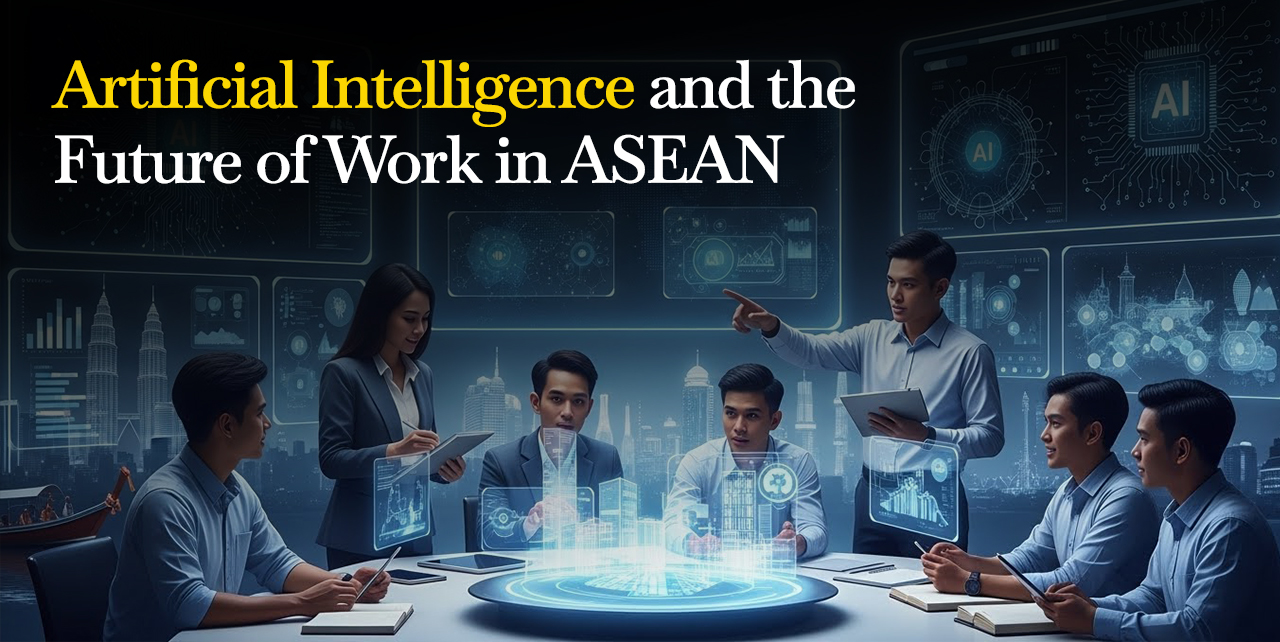
Artificial intelligence is fundamentally transforming how work gets done across Southeast Asia. With an estimated 164 million workers potentially impacted by generative AI, ASEAN stands at a critical juncture. The region must balance AI’s tremendous productivity potential against risks of displacement, inequality, and widening skills gaps.
1. ASEAN’s AI Governance Framework
ASEAN has taken a principles-based approach to AI governance, prioritising innovation whilst establishing ethical guardrails.
Key regional developments:
- ASEAN Guide on AI Governance and Ethics (2024): Establishes core principles including transparency, fairness, security, reliability, privacy, accountability, and human centricity
- Expanded Guide on Generative AI (2025): Addresses unique risks of generative AI, including hallucinations, deepfakes, privacy violations, and embedded biases
- Worker privacy protections: Guidelines on AI use for employee surveillance and monitoring, balancing productivity with privacy rights
- Voluntary framework: Unlike binding EU regulations, ASEAN’s approach remains non-binding, enabling members to tailor governance to their specific contexts
The frameworks emphasise that governance is not just about compliance but about enabling ASEAN nations to use AI responsibly whilst preserving cultural values.
2. The Employment Impact
AI is simultaneously displacing existing jobs whilst creating new opportunities, with uneven effects across skill levels and demographics.
Current workforce impacts:
- Robot adoption effects (2018-2022): Created 2 million jobs for skilled formal workers but displaced 1.4 million low-skilled workers in five ASEAN countries
- Generative AI exposure: 57% of Southeast Asia’s workforce (164 million workers) have roles with potential exposure to generative AI
- Disproportionate impact: Studies suggest that over 70% of women and up to 76% of Gen Z workers are concentrated in roles likely to be augmented or disrupted by GAI
- Limited AI complementarity: Under current task structures, only 10% of jobs in East Asia-Pacific involve tasks complementary to AI, compared to 30% in advanced economies
The key question is not whether AI will replace jobs, but whether organisations will empower people to evolve with it.
3. The Skills Gap
The pace of technological change is outstripping workforce readiness across the region.
Skills transformation reality:
- Accelerating change: Skills needed for any job have changed by 40% since 2016; with GAI adoption, skills will change by 72% by 2030
- Employer dissatisfaction: In parts of ASEAN, 75% of employers say recent graduates are not job-ready
- Reskilling urgency: 59% of workers worldwide will need reskilling by 2030 to meet changing demands
- Limited AI talent pool: Whilst AI professionals in the region tripled from 2016 to 2024, ASEAN’s AI talent pool remains small compared to other emerging and high-income countries
Critical skills for the AI era:
- Resilience and adaptability
- Creative problem-solving
- Continuous upskilling capability
- Interpersonal savvy
- Critical thinking
These are durable human capabilities that AI cannot replicate.
4. Major Skilling Initiatives
Governments and corporations are investing heavily in preparing ASEAN’s workforce for the AI economy.
Large-scale training programmes:
- Microsoft (2024-2025): Commitment to equip 2.5 million people across Indonesia, Malaysia, the Philippines, Thailand, and Vietnam with AI skills
- Google.org/ASEAN Foundation: USD 5 million AI Ready ASEAN programme targeting 5.5 million learners with AI Class ASEAN e-learning platform featuring 70 localised modules
- ASEAN Year of Skills 2025: Regional initiative supported by ILO to guide deeper conversations on human capital development
Sector-specific initiatives:
- Thailand: AI Skills for Tourism Industry programme skilling 100,000 young entrepreneurs across all regions
- Philippines: Microsoft equipping 1 million Department of Education learners (K-12) with AI and cybersecurity skills
- Indonesia: 100,000 underserved youths trained through Kartu Prakerja partnership
- Malaysia’s National Training Week (2025): Offering 65,000 high-quality skills training courses to all ASEAN citizens

5. Business Implications
Companies operating in ASEAN must navigate both opportunities and obligations as AI reshapes work.
Strategic workforce actions:
- Skills-based hiring: Focusing on abilities rather than traditional qualifications can expand the global AI talent pool by up to 7.4 times
- Continuous upskilling: Embed learning into organisational culture
- AI governance structures: Establish internal oversight for responsible AI deployment
- Worker privacy compliance: Follow ASEAN guidelines when using AI for employee monitoring
- Inclusive transition support: Provide pathways for workers in at-risk roles to transition
Many organisations report significant productivity improvements, particularly in coding, writing, and customer support.
Image: Business AI adoption framework
6. National Strategies
Member states are implementing varied AI strategies reflecting different levels of readiness and priorities.
Leading initiatives:
- Singapore: Model AI Governance Framework for Generative AI (2024) emphasising transparency and risk assessment; Privacy Enhancing Technologies Sandbox for testing
- Malaysia: National AI Roadmap (2021-25) promoting responsible AI across agriculture, healthcare, smart cities, education, and public services; National Artificial Intelligence Office (launched December 2024) to strengthen coordination across agencies
- Indonesia: Microsoft’s USD 1.7 billion AI and cloud investment; improving rural connectivity to support AI and digital service adoption
- Brunei: Developing national AI strategy under Digital Economy Masterplan 2025; Guide on AI Governance and Ethics published
- Thailand: ThaiLLM language model supporting startups and SMEs; reducing reliance on foreign AI solutions
Image: ASEAN AI readiness comparison
7. Building an Inclusive AI Economy
ASEAN’s AI transformation will determine the region’s competitiveness, equity, and prosperity for decades to come.
Critical success factors:
- Regional coordination: Sharing standards and practices across member states
- Investment in education: Rethinking curricula to emphasise AI literacy and critical thinking from early education onwards
- Social safety nets: Developing support systems for workers transitioning between roles
- Ethical AI deployment: Prioritising human welfare alongside productivity gains
- Research capacity: Building scientific expertise to develop ASEAN AI tools
The 2025 AI and Workforce Transformation report emphasises that with coordinated policies, ASEAN can turn workforce disruption into shared opportunity.
Image: ASEAN AI transformation roadmap
AI’s impact on ASEAN’s workforce is not predetermined. The region’s response – through governance frameworks, skills development, business adaptation, and social support- will shape whether AI amplifies inequality or enables inclusive prosperity.
Early movers who invest in capability building, embrace skills-based approaches, and prioritise ethical AI deployment will emerge as leaders in the AI-powered economy. Those who delay risk leaving their workforce underutilised and unprepared.
The window for proactive preparation remains open, but it is narrowing. Businesses, governments, and workers must act now to ensure ASEAN’s 700 million people benefit from AI’s transformative potential.
Sources
- ASEAN (2024). “ASEAN Guide on AI Governance and Ethics”
- ASEAN (2025). “Expanded ASEAN Guide on AI Governance and Ethics – Generative AI”
- Access Partnership (2025). “Understanding How AI Impacts Jobs and Skills in ASEAN”
- World Bank (2025). “Future Jobs: Robots, Artificial Intelligence, and Digital Platforms in East Asia and Pacific”
- AI Asia Pacific Institute (2025). “AI and Workforce Transformation: Unlocking Pathways to Inclusive Growth in ASEAN Developing Economies”
- Pearson (2025). “AI and the Future of Work in Southeast Asia: Fixing the Skills Gap”
- Microsoft (2024). “Microsoft announces AI skilling opportunities for 2.5 million people in the ASEAN region by 2025”
- ASEAN Foundation (2025). “AI Ready ASEAN”
- World Economic Forum (2025). “How Malaysia has been preparing its workforce for the future”
NBR (2024). “Charting ASEAN’s Path to AI Governance: Uneven Yet Gaining Ground”