
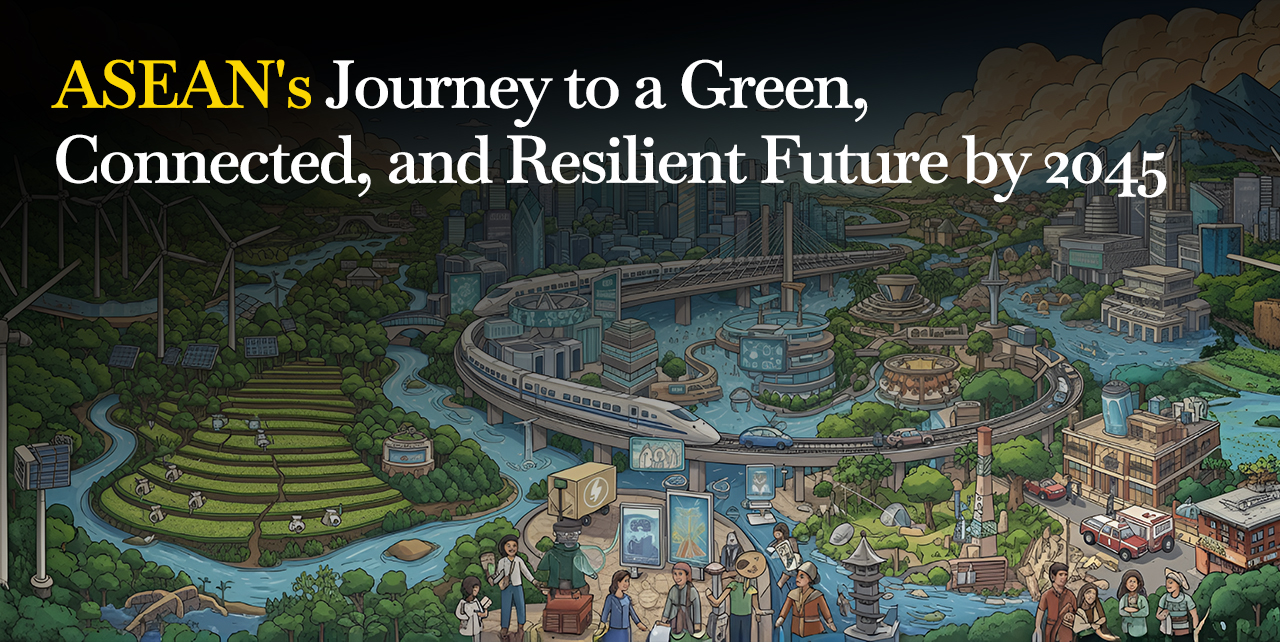
ASEAN is entering a decade where climate threats, economic transitions, and technology shifts will shape its long-term trajectory. The region’s leaders recognise that incremental change is no longer enough. To thrive by 2045, ASEAN is steering towards a future built on four pillars: green transformation, digital connectivity, climate resilience, and sustainable development.
This vision is grounded in ongoing regional frameworks, national climate strategies, and a broader commitment to protect Southeast Asia’s people, ecosystems, and economic competitiveness.
1. A Green Transformation Anchored in Climate Ambition
ASEAN faces some of the world’s most severe climate impacts, rising sea levels, intense heatwaves, and monsoon disruptions. As a result, climate action is now placed at the centre of its long-term strategy.
Key regional priorities
- Strengthening Nationally Determined Contributions (NDCs): Member States continue to revise their climate targets, with many setting net-zero ambitions and sector-specific decarbonisation pathways.
- Expanding renewable energy: Solar, wind, hydropower, and geothermal resources remain the backbone of the region’s clean energy transition.
- Integrating nature-based solutions: Forest restoration, mangrove rehabilitation, social forestry models, and peatland protection are becoming essential components of national climate plans.
- Regional energy cooperation: Cross-border energy trade, such as the ASEAN Power Grid, aims to expand renewable energy flows across economies.
The direction is clear: ASEAN wants an energy system that can support economic growth while reducing emissions at scale.
2. Building a Highly Connected Digital Region
ASEAN’s digital transformation is accelerating faster than many other global blocs. By 2045, connectivity will act as one of the region’s strongest development enablers.
Strategic digital priorities
- Implementing the ASEAN Digital Economy Framework Agreement (DEFA): This is the region’s most ambitious digital integration blueprint, designed to strengthen trust, data flows, consumer protection, and interoperability.
- Expanding digital public infrastructure: Digital IDs, e-payments, and interoperable platforms support inclusive growth.
- Using technology to manage climate risks: Satellite mapping, early warning systems, and AI-based modelling help governments prepare for floods, droughts, and heat events.
- Ensuring digital inclusion: Efforts continue to close gaps in connectivity, digital literacy, and access, especially among rural communities, women, micro-businesses, and vulnerable workers.
By bridging digital divides, ASEAN aims to create a future where innovation and technology support greener and more inclusive development.
3. Strengthening Climate and Disaster Resilience
Southeast Asia sits at the frontline of climate impacts. The path to 2045 demands stronger systems to safeguard communities, infrastructure, and ecosystems.
Key resilience measures
- Advancing regional climate adaptation plans: Countries are developing and updating National Adaptation Plans and long-term resilience frameworks.
- Managing transboundary climate risks: Haze episodes, river basin challenges, marine ecosystem loss, and food security disruptions are tackled through cross-border coordination.
- Mobilising climate finance: ASEAN aims to close the adaptation finance gap through blended finance, public–private partnerships, and global climate funds.
- Enhancing disaster preparedness: ASEAN’s coordination mechanisms continue to evolve, improving response capacity for typhoons, floods, droughts, and extreme weather.
Resilience is becoming a core pillar of regional planning, investment, and governance.
4. Supporting Sustainable and Inclusive Development
ASEAN’s 2045 vision goes beyond environmental goals. It emphasises human development, gender equality, and stronger social systems that can support a thriving green economy.
Key areas of focus
- Women’s empowerment: Integrating gender perspectives into climate solutions, digital strategies, and economic participation.
- Sustainable cities: Urban planning that reduces pollution, enhances public transport, and expands green infrastructure.
- Circular economy models: Reducing waste, improving resource efficiency, and strengthening recycling industries.
- Nature-positive growth: Protecting forests, oceans, biodiversity corridors, and agricultural ecosystems essential for food security and community livelihoods.
A sustainable ASEAN is one where people benefit as much as the environment.
5. The Path Forward – Collaboration, Innovation, and Shared Responsibility
ASEAN’s long-term transformation relies on a combination of regional solidarity, science-driven decision-making, and inclusive investment. The vision for 2045 recognises that climate action, digital growth, and resilience cannot be achieved in isolation. Sector by sector, ASEAN is building a future where cities are cleaner, economies are more competitive, ecosystems are protected, and people are more empowered.
The next two decades will determine the region’s climate stability, economic strength, and global relevance. By aligning strategies across governments, businesses, and communities, ASEAN is shaping a green, connected, and sustainable tomorrow for its 700 million people.
Source: https://asean.org/wp-content/uploads/2024/02/Issue-34-35-Issue-34-35-ASEAN-2045_-Shaping-a-Green-Connected-and-Sustainable-Tomorrow.pdf