

When countries gathered in Paris in 2015 to sign the landmark Paris Agreement, they set ambitious climate goals. But achieving these goals requires national efforts and also demands global cooperation. That’s where Article 6 comes in.
What Exactly Is Article 6 of the Paris Agreement?
Article 6 is the section of the 2015 Paris Climate Agreement that sets rules for international carbon markets and climate cooperation. It’s about creating flexible mechanisms so countries can collaborate to meet their Nationally Determined Contributions (NDCs) and their climate targets.
Instead of each country reducing emissions in isolation, Article 6 allows nations to:
- Buy and sell carbon credits
- Fund projects abroad that reduce emissions
- Transfer emissions reductions between countries
This creates a global system that can lower the cost of climate action while driving funding into climate-positive projects worldwide.
Why Is Article 6 Important?
Climate change is a global issue, but until now, emissions reductions have mostly been handled domestically. Article 6 changes that by allowing:
- Cross-border collaboration on climate action
- Private sector involvement in carbon markets
- Reduced costs for meeting climate goals
- Acceleration of green investments in developing countries
Without Article 6, it would be much harder and much more expensive for the world to stay on track with the 1.5°C global warming limit.
Breaking Down Article 6: The Three Key Parts
| Subsection | Purpose |
|---|---|
| Article 6.2 | Allows for bilateral or multilateral agreements between countries to trade Internationally Transferred Mitigation Outcomes (ITMOs). This is the mechanism behind government-to-government carbon trading. |
| Article 6.4 | Creates a new UN-managed global carbon market, similar to the Clean Development Mechanism from the Kyoto Protocol, but with stricter sustainability criteria. It will allow both public and private entities to participate. |
| Article 6.8 | Focuses on non-market approaches, such as technology sharing, capacity building, and climate finance without carbon trading. |
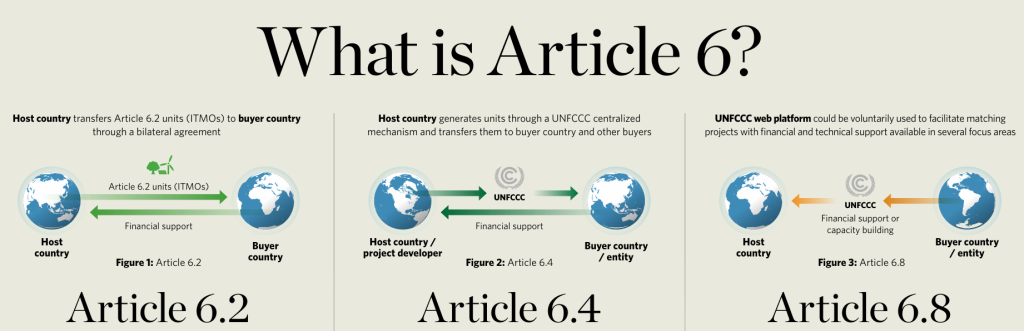
Image: Article 6 Structure
What is a Carbon Credit?
A carbon credit represents one metric ton of CO₂ equivalent that has been reduced, avoided, or removed from the atmosphere.
How Carbon Credits Work:
| Step | Description |
|---|---|
| 1. A project reduces emissions | For example, planting trees or building a renewable energy plant |
| 2. The project is verified | A third-party auditor confirms the reductions |
| 3. Credits are issued | Each credit = 1 ton of CO₂ avoided or removed |
| 4. Credits are traded or retired | Countries or companies buy them to offset their emissions |
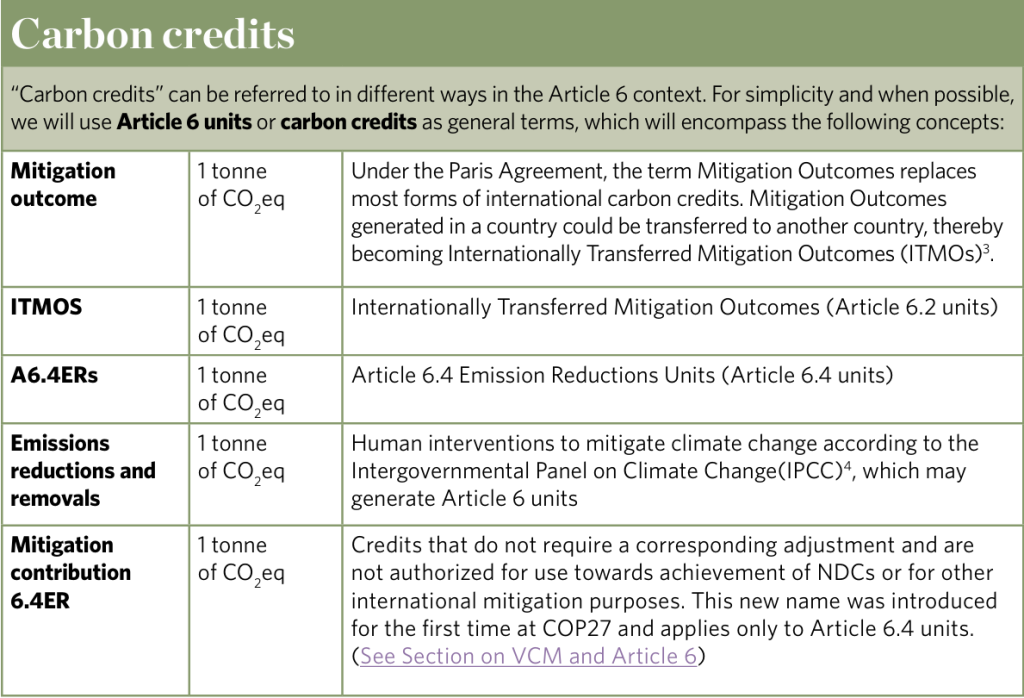
Image: Carbon Credits
Resource: https://www.nature.org/content/dam/tnc/nature/en/documents/c/m/CM-TNC-Article-6-Explainer.pdf
Where Are We Now in the Journey?
The road to implementing Article 6 of the Paris Agreement has been long, complex, and at times uncertain. But over the last decade, crucial steps have been taken to turn its flexible mechanisms into a functioning global carbon market. Here’s how the journey has unfolded:
2015 – The Paris Agreement Is Born
- Article 6 is introduced as part of the landmark Paris Climate Accord, allowing countries to collaborate on emissions reductions.
- However, it lacks operational details that countries agree in principle but not in practice.
2018 – Katowice Rulebook (COP24)
- Negotiators begin hashing out the technical rules for Article 6.
- Deadlock arises over how to avoid double-counting and whether old Kyoto-era credits should carry over.
2021 – Breakthrough at COP26 (Glasgow)
- After years of stalled talks, countries finally adopted the Article 6 Rulebook.
- Key agreements include:
- Framework for Article 6.2 bilateral cooperation
- Establishment of the Article 6.4 mechanism, a new global carbon market under UN oversight
- Basic safeguards for environmental integrity
2022–2023 – Early Pilots and Testing
- First Article 6 pilot programs begin to roll out:
- Switzerland signs bilateral deals with Peru, Thailand, and Ghana under Article 6.2.
- Thailand makes the world’s first ITMO transfer for an electric bus project in Bangkok.
- Countries begin to set up domestic authorization procedures and explore registry infrastructure.
2024 – Formalization and Expansion
- At COP29 (Baku, Nov 2024), the final Article 6 operational rules are adopted.
- Singapore signs multiple Article 6 Implementation Agreements with countries in Africa, Latin America, and the Pacific.
- More than 80 bilateral agreements are now in place globally, linking buyers like Norway, Japan, and Singapore with developing host countries.
ASEAN Steps Up on Article 6 Integration
Singapore
- Continues to lead the region with multiple bilateral agreements already signed under Article 6.2 with Peru, Ghana, Bhutan, Papua New Guinea, and Chile.
- In early 2025, Singapore entered advanced talks with Thailand to secure its first ASEAN-region Article 6 carbon deal, signaling the start of regional carbon cooperation.
Thailand
- Gained international attention in 2024 by executing the world’s first ITMO transfer (electric bus project with Switzerland).
- In 2025, Thailand is finalizing domestic regulatory frameworks to scale participation in Article 6.2 transactions across the region.
Indonesia and Malaysia
- Both nations have developed carbon verification systems centered on forestry and nature-based credits.
- However, they remain cautious about international credit transfers, prioritizing national climate targets.
- In 2025, both countries are refining “corresponding adjustment” policies to align with Article 6 requirements.
Vietnam and the Philippines
- These countries are focusing on building domestic carbon markets first.
In 2025, they are undergoing capacity-building programs with support from the UNFCCC and multilateral development banks, laying the groundwork to join Article 6 markets in the coming years.
What This Timeline Shows
- From concept to implementation, Article 6 has moved from political vision to real-world market operations.
- As of 2025, we are now in the execution phase: actual credit transfers, country frameworks, and capacity-building across developing regions, including ASEAN.
However, challenges remain; ensuring transparency, avoiding double-counting, and maintaining high environmental integrity are critical for these markets to succeed.
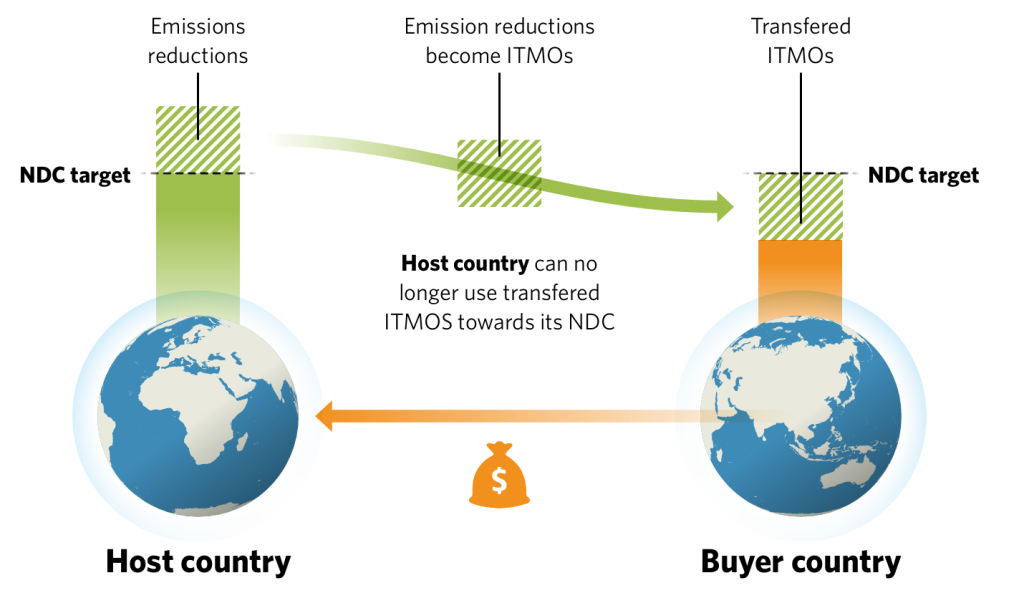
Image: Double Counting
Read More: https://www.nature.org/content/dam/tnc/nature/en/documents/TNC_Article_6_Explainer.pdf