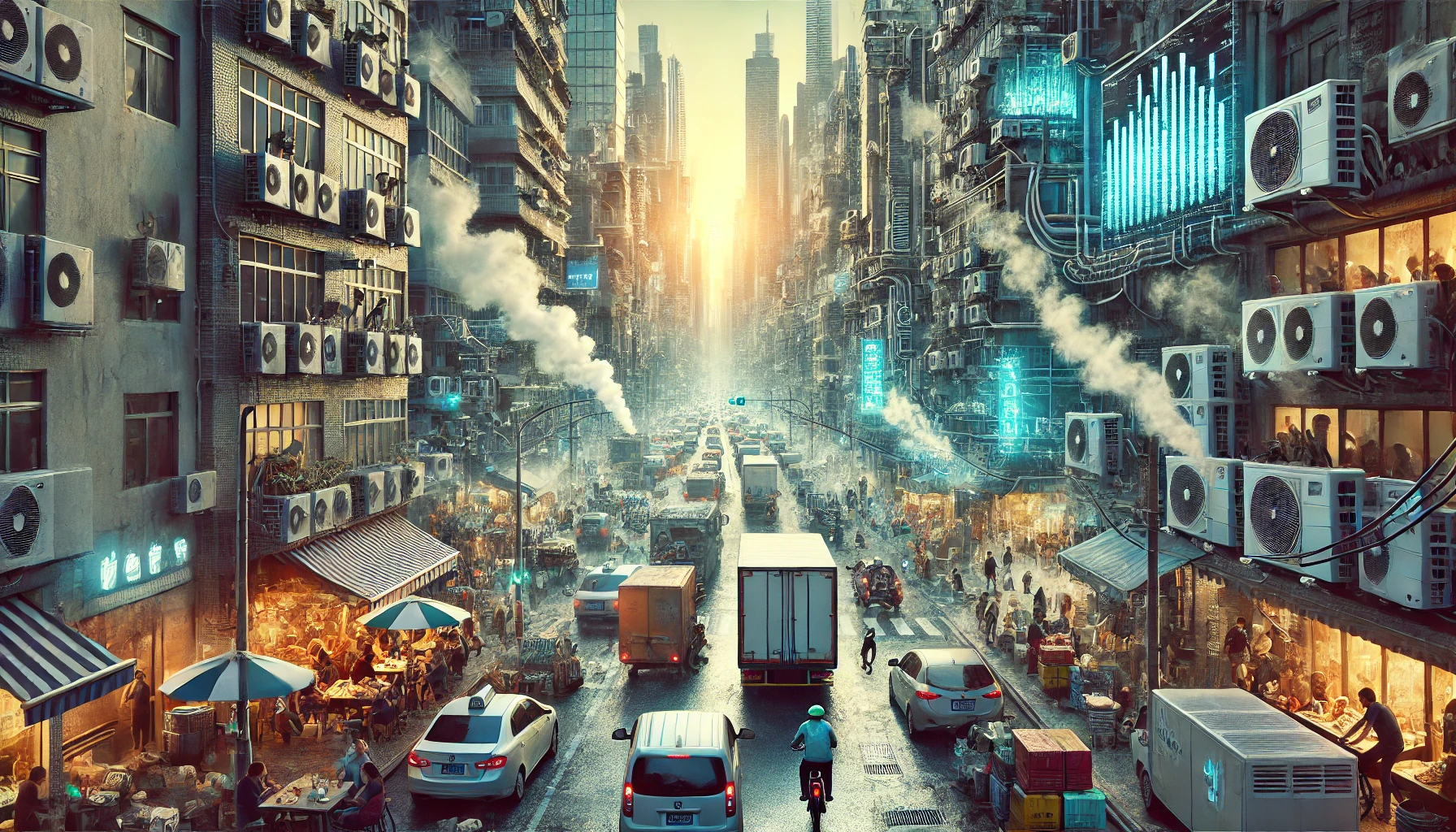
Imagine waking up as a resident in a rapidly growing city. The first thing you hear is the hum of air conditioners and the distant sound of traffic already building on the streets. As you step out of your apartment, the sidewalks are busy with people rushing to offices, cafes releasing clouds of coffee aroma into the morning air, delivery bikes weaving between cars, and exhaust smoke curling upward, mixing with the morning haze.
It’s a typical morning in a city chasing growth but struggling to keep balance. Energy use is relentless, hot showers powered by gas. Stovetops lit for breakfast. Air conditioners are already running full blast before noon. Most commuters still drive fuel-burning cars instead of electric ones. By midday, everything speeds up, with more fuel being burned, more emissions released into the air, and more energy being drained from already strained power grids.
What about waste?
It’s everywhere, but most of us don’t notice. Behind cafes and restaurants, food waste piles up. Plastic bags drift near drains after lunch. Water runs from faucets, slips into polluted rivers, and no one thinks twice. Trash bins overflow. Recycling? It’s still something people mean to do, but often don’t.
But the problem isn’t just environmental, but also about people.
Take a look around. Is this city built for everyone? Can a person with disabilities cross the street safely? Can someone in a wheelchair find ramps or get through crowded sidewalks without a fight? What about someone who’s blind? Can they navigate the streets confidently, knowing the city has thought about their needs?
Health Problems.
The air people breathe is laced with dust and smoke. Construction workers labor without proper safety gear, handling toxic materials, because no one enforces the rules. People drink water every day without knowing what’s in it. These aren’t just environmental risks. They pose health risks. And over time, they add up.
In the race to grow, a lot of things get left behind. Community inclusion. Fair wages. Safe working conditions. The people at the bottom of the ladder are stuck with low pay and unstable jobs, while someone else counts the profits. Neighborhoods change so fast that families barely recognize them anymore. People grow afraid to celebrate their culture, slowly losing their roots while ‘progress’ marches on. Public spaces are built for convenience, not for connection. They’re not designed to bring people together; they’re designed to move people along.
If you stop and look, you have to ask: Are we building cities for people? Or just for profit? Every day, these unchecked habits chip away at the balance, polluting the air, filling landfills, excluding people, and leaving workers behind. And this isn’t happening in just one place. Multiply this by every city in the world. The result? Mountains of waste. Dirty air. Disappearing green spaces. Growing social divides.
We’re already living in the aftermath of ignoring the balance between the environment, fairness, and human health. This can’t keep going. If we want a different future, we have to rethink not just how we build, but how we live inside what we build. Sustainability isn’t just about eco-friendly buildings or greener tech. It’s about creating places that work for people and the planet. Fairly. Responsibly. Together.
No matter how dark the cloud, there is always a thin silver lining
The good news is, there’s a growing movement to change this, and it starts with rethinking how buildings and infrastructure can support not just environmental goals, but social ones too. Recent research by the World Green Building Council (WorldGBC) and VTT Technical Research Centre of Finland) highlights how socially sustainable buildings and infrastructure can foster inclusive, connected, and thriving communities. Here’s how social sustainability is redefining the future of urban development and why it matters now more than ever.
What Is Social Sustainability in the Built Environment?
Social sustainability in this context refers to how buildings and infrastructure positively impact people’s lives physically, emotionally, and socially, during their construction, use, and eventual decommissioning. It includes factors such as:
- Accessibility
- Health and Safety
- Community inclusion
- Fair labor conditions
- Cultural continuity
In simple terms, a socially sustainable building is safe, inclusive, usable, and meaningful for everyone it touches.
Why Social Sustainability Is Just as Important as Environmental Sustainability
While green design focuses on energy, emissions, and efficiency, social sustainability prioritizes the well-being of people. WorldGBC’s “Creating Better Places for People” report stresses that buildings shape the human experience where we live, work, learn, and heal. If these spaces exclude, harm, or isolate, they can damage mental health, divide communities, and deepen inequality.
Moreover, socially sustainable projects enhance environmental goals by fostering local ownership, behavioral change, and long-term resilience.
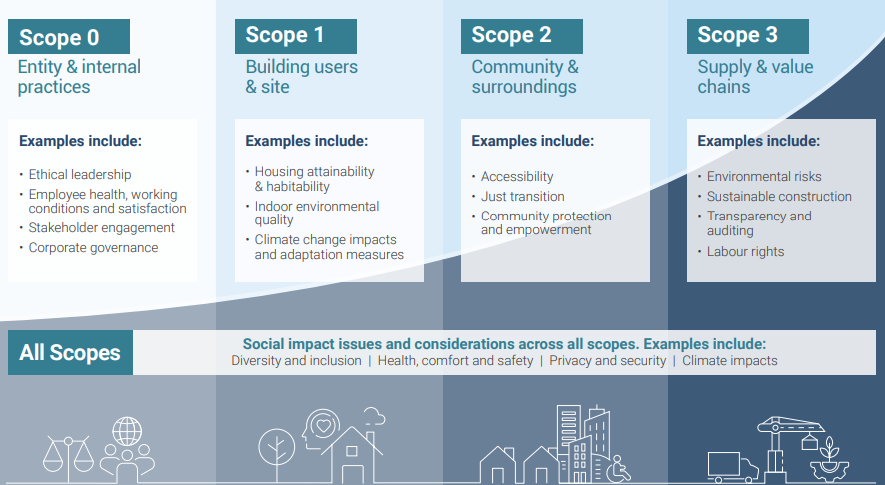
WorldGBC’s Four scopes of social impact on the built environment
To ensure that social impact is not an afterthought, WorldGBC proposes a framework inspired by greenhouse gas accounting. It breaks down social impacts across four scopes:
- Scope 0: Immediate impacts on occupants (e.g., safety, comfort, inclusion).
- Scope 1: Construction-phase impacts (e.g., labor rights, neighborhood disruption).
- Scope 2: Supply chain effects (e.g., working conditions in material production).
- Scope 3: Broader societal issues (e.g., affordability, long-term cohesion).
This model encourages planners and developers to take a comprehensive, human-centered approach, not just design for efficiency, but design for dignity.
VTT’s Seven Dimensions of Social Sustainability in Practice
VTT Research has developed a data-driven framework that focuses on how social sustainability is realized during the use phase of buildings and urban areas. Their model includes:
- Accessibility
- Health and Safety
- Usability
- Stakeholder Participation
- Shared Spaces & Community
- Solution Resilience
- Sustainable Growth
Each area can be measured using over 300 indicators to guide evidence-based decision-making. For example, urban planners might evaluate how well a district promotes walkability, how accessible its public buildings are, or how safe shared spaces feel at night.
Real-World Applications and Benefits
Projects include:
- Mixed-income housing that preserves cultural identity.
- Workplaces designed for neurodiversity and mental health.
- Construction processes that uphold labor rights across global supply chains.
The result? Stronger communities, lower turnover, better public trust, and more resilient cities.
Looking Ahead: The Future of Social Sustainability
- Design spaces that adapt to people’s needs.
- Make affordability and inclusion part of ESG metrics.
- Prioritize long-term well-being over short-term profit.