
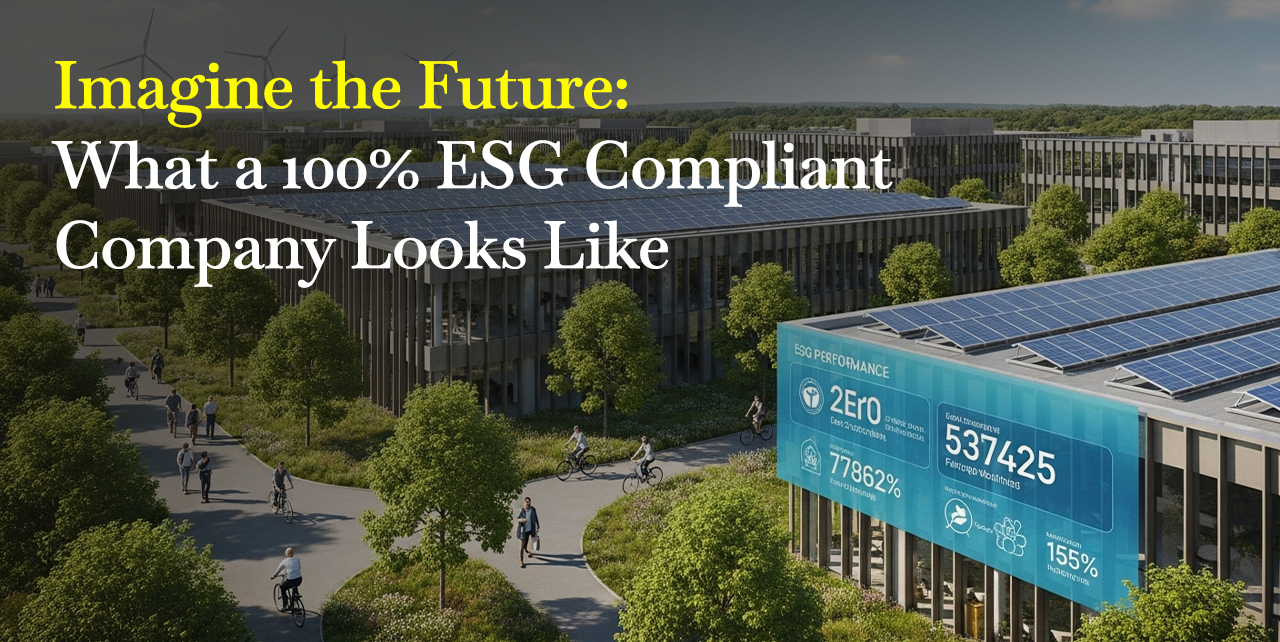
Imagine walking into a company where every decision, every policy, and every product reflects deep care for the planet, people, and the long-term stability of the business. This is not a future dream; it’s a powerful concept grounded in today’s practices.
This company doesn’t just publish sustainability reports once a year. Instead, it bases its business model on Environmental, Social, and Governance (ESG) values. Its offices run on clean energy. Its people are trained not just in operations, but in climate ethics and community impact. Every supplier is selected with care. Every financial decision is weighed for both risk and responsibility.
What Is a 100% ESG Compliant Company?
Let’s explore what this company looks like from the inside out.
Governance and Strategy
- Board leadership reflects ESG values. Picture a boardroom with gender, ethnic, and generational diversity, each seat held by leaders who understand both financial performance and climate risk. They’ve undergone training and are committed to ethical, forward-thinking governance.
- Executive accountability is redefined. CEOs and top management have their bonuses tied not just to profits, but to reductions in carbon emissions, workforce diversity targets, and ethical supply chain performance.
- Reporting is transparent and global in standard. The company doesn’t just talk the talk. It reports its progress using international frameworks like the Global Reporting Initiative (GRI), TCFD, or SASB, making it easy for investors, regulators, and the public to hold them accountable.
- Strategic planning includes climate scenarios. When preparing its five-year roadmap, the company models multiple climate futures, ensuring resilience in drought, regulation, or shifting consumer values.
Human Capital and Workforce
- Diversity and inclusion are core values. Hiring isn’t just skill-based. It actively looks for underrepresented voices. Leadership reflects the global community it serves.
- Training is built into every job role. Whether you’re in HR or logistics, every employee understands how their actions connect to environmental goals, ethical practices, and social inclusion.
- Health and well-being are part of success. Mental health resources, ergonomic workplaces, and flexible work options are treated as serious performance drivers, not perks.
- Labor rights are protected everywhere. Whether on-site or across the supply chain, there’s no room for exploitation. The company partners only with suppliers who meet strict labor, wage, and safety standards.

- Risk is priced into every deal. Investments are not approved without considering long-term environmental and social impacts. Projects are modeled for carbon cost, community acceptance, and reputational risk.
- Sustainable finance tools are standard. Instead of traditional bank loans, the company raises capital through green bonds, loans, or impact investing funds that reward sustainable behavior.
- Carbon has a financial cost. An internal carbon pricing system helps the company prioritize low-emission decisions, even when regulations don’t demand it.
- M&A decisions include ESG due diligence. Before acquiring a company, its environmental footprint, human rights record, and governance practices are thoroughly reviewed.
Supply Chain and Procurement
- Suppliers are ESG partners. Before signing contracts, suppliers are assessed not just on cost and quality, but on ethical sourcing, energy use, waste management, and treatment of workers.
- Third-party audits ensure credibility. Every supplier is subject to regular, independent audits for issues like forced labor, carbon intensity, or anti-corruption practices.
- Contracts include clear clauses. Suppliers are legally bound to meet sustainability standards, with consequences for violations.
- Local and ethical sourcing is prioritized. Whenever possible, the company supports local economies and deforestation-free sourcing to reduce transport emissions and build resilient regional systems.
Environmental Management and Operations
- All facilities are net-zero. Whether it’s a factory, office, or warehouse, the company uses 100% renewable energy, offsets remaining emissions, and integrates smart systems to monitor efficiency.
- The circular economy is built in. Waste is minimized through reuse, recycling, and product design that anticipates disassembly or reuse. Nothing goes to landfill without cause.
- Environmental audits guide improvement. Every year, independent experts assess water use, energy, biodiversity impact, and emissions to push for constant improvement.
- Products are designed for sustainability. From biodegradable packaging to modular electronics, everything is created to minimize impact, right down to its end of life.
How Different Industries Would Operate With 100% ESG Integration
Construction
Imagine a building that breathes with the environment. Using LEED-certified or BREEAM-approved materials, solar-integrated facades, and smart insulation, construction firms reduce energy consumption and carbon emissions. On-site, workers are protected by safety-first policies, while surrounding ecosystems are preserved through biodiversity assessments before the first dig.
Apparel
Your clothes are no longer part of the fast fashion cycle. Instead, they’re created from organic or recycled materials in ethically audited factories. Workers receive living wages, and water is carefully monitored and reused. After use, you can return garments through a textile recycling program, closing the loop.
Pharmaceuticals
Every medication is developed not just for efficacy but for access. Clinical trials engage local communities with consent and fairness. Packaging is minimal, plastic-free, and sustainably sourced. The entire production line is optimized for low-emission operations, with transparency from lab to pharmacy.
Agriculture
Visualize a farm with no chemical runoff, where soil is rich from regenerative farming, and water use is monitored via satellite. Workers are trained and protected, and crops are ethically sourced for local and global markets. Each product has a QR code tracing its origin and impact.
Trade & Logistics
Goods are transported using electric fleets and low-emission vessels. Packaging is recyclable or reusable. Every route is optimized to minimize fuel. Warehouses are powered by solar energy, and logistics staff are trained in waste reduction and compliance.
Technology and Digital Services
Imagine a data center powered entirely by wind and solar, cooled by reclaimed water. AI models are designed with ethical audits, ensuring no bias or data misuse. Devices are built with ethically sourced minerals, and customers can return old devices for certified recycling.
Why Most Companies Are Not Yet 100% ESG-Compliant?
While leading companies are progressing, most businesses today still struggle with:
- separated teams disconnected from finance or operations
- Inconsistent measurement and vague metrics
- Limited supply chain visibility beyond Tier 1 suppliers
- Short-term priorities outweigh long-term value creation
- Lack of expertise at the leadership level
How to Close the Gap
To shift from partial efforts to full integration:
- Start with leadership education. Giving knowledge about the concept to executives and board members is essential. Without it, strategy and governance fall short.
- Include in every process. From procurement to R&D, sustainability must be an embedded metric, not an afterthought.
- Use global frameworks. Follow GRI, TCFD, or SASB standards to ensure data credibility and comparability.
- Enhance supply chain transparency. Invest in traceability tools and conduct third-party audits, not just questionnaires.
- Measure what matters. Use real KPIs (e.g., Scope 1–3 emissions, gender pay gap, ethics violations) and report progress openly.
The Ideal Company Is No Longer a Dream
When this concept becomes more than a policy and turns into a practice, businesses don’t just survive, they lead. This shift won’t happen overnight, but it will happen faster for those who commit early, measure honestly, and build deeply. If you’re imagining what a sustainable, ethical, and resilient company looks like, you’ve already taken the first step.